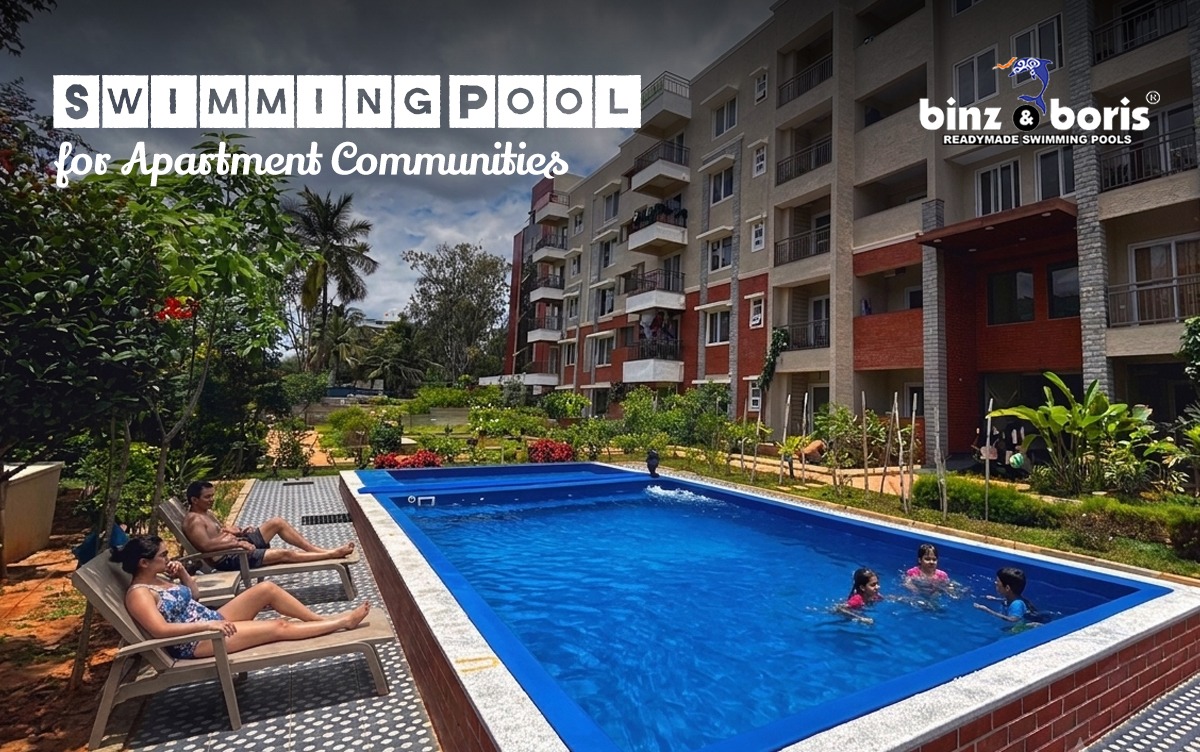
Swimming Pool for Apartment Communities: Complete Guide
A swimming pool for apartment communities is no longer viewed merely as an optional luxury — it has become a core lifestyle and recreation feature expected by homebuyers and residents across urban housing societies, gated communities, and residential clubhouses.
A well-planned amenity package defines the appeal, resident satisfaction, and long-term positioning of modern residential developments. Today, a swimming pool for apartment communities is no longer viewed merely as an optional luxury—it has become a core lifestyle and recreation feature expected by homebuyers and residents across urban housing societies, gated communities, and residential clubhouses.
However, incorporating an apartment community swimming pool via traditional civil construction often introduces significant execution challenges for property developers, Resident Welfare Associations (RWAs), and facility managers. Conventional in-ground concrete builds demand extensive excavation, heavy civil works, complex waterproofing layers, prolonged project timelines, and high ongoing upkeep. For urban properties with limited spatial footprints or strict completion schedules, alternative solutions—such as modern readymade and above-ground fiberglass swimming pools—offer an efficient route to deliver high-quality aquatic amenities without the friction of lengthy site work.
1. Why Swimming Pools Are Valuable in Apartment Communities
Integrating a swimming pool for residential apartments offers clear operational, social, and aesthetic advantages for developers, community boards, and residents alike:
- Lifestyle & Recreational Amenity: A dedicated aquatic facility provides residents of all age groups with immediate access to leisure, relaxation, and low-impact exercise without leaving the premises.
- Community Engagement: The pool deck naturally functions as a central social hub, fostering community interaction and elevating the living experience in gated developments.
- Fitness & Health Support: Aquatic exercise, lap swimming, and water therapy support resident health and active living initiatives right at home.
- Property Marketability: Thoughtfully designed amenities enhance the overall market appeal, visual presentation, and buyer perception of residential complexes during launch and resale phases.
- Clubhouse Experience: A swimming pool for an apartment clubhouse serves as an architectural anchor, turning standard common areas into premium recreational destinations.
Note: While high-quality amenities enhance overall project appeal and market speed, actual valuation impact varies based on location, micro-market demand, architectural execution, and ongoing facility management.
2. What Type of Swimming Pool Is Best for an Apartment Community?
Selecting the right structural type depends on site topography, available footprint, structural capacity, and construction timelines.
Traditional In-Ground Swimming Pools
Traditional concrete (gunite or civil) pools are built directly into the ground through excavation, reinforced steel work, concrete pouring, tiling, and specialized waterproofing.
- Advantages: High degree of custom shapes, variable depths, and permanent integration into ground-level landscaping.
- Considerations: Requires heavy site work, multi-month construction schedules, continuous risk of tile/waterproofing degradation over time, and high site disturbance.
Above-Ground & Readymade Fiberglass Swimming Pools
A readymade swimming pool for apartments utilizes pre-engineered, high-strength fiberglass reinforced polymer (FRP) shells that are manufactured off-site under controlled factory conditions and delivered ready to install.
- Advantages: Rapid on-site setup, minimal excavation, smooth non-porous surfaces that resist algae growth, integrated structural integrity, and flexible installation options.
- Structural Versatility: Above-ground fiberglass models can be installed on elevated concrete slabs, podiums, basements, or flat ground surfaces with simplified civil preparation.
Manufacturers like Binz & Boris specialize in readymade fiberglass swimming pools designed for versatile placement—including ground-level decks, basements, indoor wellness centers, and podium structures.
Structural Qualification: Installing any pool on an elevated slab, podium, or rooftop requires prior verification by a qualified structural engineer to ensure load-bearing capacity, static/dynamic weight tolerance, and adequate drainage infrastructure.
3. Key Factors to Consider Before Installing a Swimming Pool in an Apartment Community
Executing a seamless installation requires evaluating technical, spatial, and safety criteria:
1. Available Footprint & Layout
Beyond the pool shell dimensions, plan for a complete amenity ecosystem:
- Non-slip deck margins around the perimeter
- Changing rooms, restrooms, and outdoor shower stations
- Secure enclosures or safety fencing
- Plant room / filtration equipment housing
- Unobstructed emergency access corridors
2. Structural Load Capacity
For elevated placements—such as podiums, clubhouses, or rooftops—water weight (approximately 1,000 kg per cubic meter) represents a substantial dead load. A structural engineering evaluation must confirm slab reinforcement, deflection limits, and weight distribution before selection.
3. Usage & Bather Load
Design capacity should match the demographic profile and population density of the housing society. Consider peak weekend usage, child-to-adult ratios, and designated exercise hours when sizing the pool shell and filtration systems.
4. Pool Depth & Safety Profile
A uniform depth (e.g., 4 feet) is widely preferred for multi-family residential communities. It offers a safe environment for leisure, casual swimming, and water exercise while eliminating hazardous drop-off zones.
5. Filtration & Water Circulation
Commercial-grade pumps, high-efficiency filters, and automated circulation loops are critical to maintaining crystal-clear water quality during high-volume usage periods.
6. Drainage & Waterproofing Management
Plan for dedicated overflow channels, backwash drainage connections, and redundant waterproofing layers to safeguard the surrounding property infrastructure from water migration.
7. Electrical Safety Standards
All underwater lighting, pump equipment, and control systems must comply with strict electrical safety codes. Ensure appropriate earthing, Residual Current Circuit Breakers (RCCB/ELCB), and isolated power feeds are installed.
8. Access Logistics & Site Preparation
Readymade fiberglass shells are transported as unified units. Assess site access, road clearances, turning radiuses, and crane setup locations required to lift the pool shell onto the designated slab or pit.
4. Can a Readymade Swimming Pool Be Installed in an Apartment Community?
Yes. Readymade fiberglass swimming pools are increasingly specified for apartment complexes, clubhouses, and gated communities seeking fast execution and leak-free reliability.
Depending on structural site feasibility, readymade pools can be deployed across several configurations:
- Ground-Level Recreation Decks: Placed in landscaped gardens or central community courtyards.
- Clubhouse Podiums: Positioned adjacent to indoor gyms, multi-purpose halls, or lounges.
- Elevated Terraces / Rooftops: Installed on engineered concrete slabs with pre-verified load ratings.
- Basement / Indoor Spaces: Configured within indoor wellness zones to offer year-round, weather-independent swimming.
Binz & Boris above-ground readymade pools are engineered specifically to overcome heavy excavation constraints, providing housing societies with an adaptable, clean installation process on flat, structurally sound surfaces.
5. Benefits of Readymade Fiberglass Swimming Pools for Apartment Communities
For community developers and facility management boards, pre-engineered fiberglass pools offer major operational advantages:
- Accelerated Project Timelines: Factory fabrication allows site preparation and pool manufacturing to happen simultaneously. Many installations are completed in days rather than months.
- Reduced Site Construction: Above-ground setups reduce or eliminate deep excavation, minimizing heavy machinery noise, dust, and disturbance in inhabited communities.
- Smooth, Durable Finish: High-grade fiberglass (FRP) features a smooth gel-coat layer that resists algae attachment, skin abrasions, and chemical breakdown.
- Integrated Technological Features: Modern units can be pre-fitted with integrated swimming pool features such as counter-current swim jets, hydromassage Jacuzzi nozzles, multi-color LED lighting, filtration units, and centralized control systems.
6. Swimming Pool Safety for Apartment Communities
Safety management is paramount in shared residential environments. Housing societies and property managers should implement robust physical and operational protocols:
| APARTMENT POOL SAFETY FRAMEWORK | |
|---|---|
| Physical & Equipment Safety | Operational & Water Safety |
| Anti-slip deck surfaces | Clearly posted pool rules |
| Secure pool enclosure / gate | Daily pH & chlorine testing |
| Emergency power cut-off switch | Designated operating hours |
| Depth indicators on pool edge | Trained lifeguard on duty |
| Lifebuoys & reaching poles | Child supervision mandate |
Manufacturers like Binz & Boris integrate multi-layer safety features into their designs—including dual suction skimmers to prevent suction entrapment, Earth Leakage Circuit Breakers (ELCB), emergency shut-off switches, password-protected controls, and flat-depth bottoms.
Disclaimer: Safety hardware must always be paired with active human supervision, clear house rules, and full compliance with local municipal health and safety codes.
7. Swimming Pool Maintenance for Apartment Communities
Establishing a structured swimming pool maintenance schedule preserves water quality, extends equipment longevity, and ensures resident health:
- Daily Tasks: Skimmer basket cleaning, surface leaf skimming, water level checks, and sanitizer/pH testing.
- Weekly Tasks: Wall vacuuming, filter backwashing/cleaning, and chemical balancing (free chlorine, pH, total alkalinity).
- Monthly/Quarterly Tasks: Pump strainer maintenance, electrical system checks, seal inspections, and deep filter media flushing.
Maintenance demands depend on pool volume, bather load, ambient weather, and filtration efficiency. Engaging an annual maintenance contract (AMC) through experienced providers helps facility managers keep systems running smoothly year-round.
8. How Much Does a Swimming Pool for an Apartment Community Cost?
The total investment for an apartment swimming pool varies based on spatial, structural, and mechanical requirements rather than shell size alone.
Primary Cost Drivers
| Cost Component | Impact on Overall Budget | Key Considerations |
|---|---|---|
| Pool Size & Shell Volume | High | Material volume, water capacity, shipping logistics |
| Installation Type | High | In-ground excavation vs. above-ground placement |
| Structural / Civil Preparation | Medium–High | Slab reinforcement, access cranes, perimeter decking |
| Filtration & Sanitation | Medium | Pump sizing, media type, automated chemical dosing |
| Specialized Equipment | Medium | Swim jets, hydrotherapy jets, heating systems |
| Lighting & Controls | Low–Medium | Underwater LED systems, automation panels |
| Site Access Requirements | Medium–High | Crane deployment, narrow access management |
Developers and RWAs should request comprehensive, site-specific proposals covering equipment supply, delivery, crane lifting, structural preparation, and commissioning.
9. How to Choose the Right Swimming Pool Manufacturer
Selecting a reliable pool manufacturer ensures project success and ongoing support. Evaluate prospective vendors against this checklist:
- Manufacturing Track Record: Look for proven experience producing commercial and residential fiberglass shells.
- Material Quality: Ensure the use of marine-grade gel coats, multi-ply fiberglass reinforcement, and UV-stabilized finishes.
- Engineering Support: Verify that the vendor provides technical layout drawings, load data, and plumbing schematics.
- Turnkey Installation Capability: Choose manufacturers capable of supporting transport, crane positioning, and equipment setup.
- Safety Integrations: Look for built-in safety engineering like ELCB protection, anti-entrapment drains, and secure control panels.
- After-Sales Service & AMC: Confirm local availability of replacement parts, technician support, and annual service contracts.
- Customization Options: Ensure options for integrated seating, hydrotherapy jets, or counter-current swim systems matching community needs.
10. Why Choose Binz & Boris for Apartment Community Swimming Pools?
Binz & Boris is a leading readymade swimming pool manufacturer in India, offering engineering-led pool solutions for residential complexes, hospitality projects, and private estates.
Key capabilities include:
- Versatile Product Formats: High-strength fiberglass pools available in above-ground, in-ground readymade, and semi-inground configurations.
- Integrated Technology: Systems can be pre-configured with high-flow filtration, swim jets, hydro-massage jets, LED lighting, and touch-panel controls.
- Simplified Logistics & Support: Comprehensive guidance on site preparation, crane installation, commissioning, and AMC support.
Planning a swimming pool for your apartment community? Contact Binz & Boris to discuss your site requirements, request structural details, and receive a customized readymade pool proposal.
Frequently Asked Questions
Yes. Apartment communities can install swimming pools at ground level, inside clubhouses, on podiums, or on rooftops, provided space, structural capacity, and local regulatory requirements are satisfied.
An above-ground readymade pool can be installed on a terrace only if a qualified structural engineer confirms the slab can safely support the static and dynamic weight of the filled pool, users, and surrounding deck.
Readymade fiberglass pools are often preferred for clubhouses due to their leak-proof construction, fast installation, low maintenance needs, and seamless integration into indoor or podium recreational spaces.
Required space depends on the chosen pool dimensions plus an additional 3 to 6 feet of clearance around the perimeter for non-slip decking, safety barriers, and filtration plant housing.
Routine maintenance involves daily water testing and debris skimming, weekly filter backwashing and chemical balancing, and periodic equipment inspections by qualified technicians.
Costs depend on pool dimensions, structural installation type (above-ground vs. in-ground), civil site work, crane access needs, filtration options, and integrated features like swim jets or lighting.
